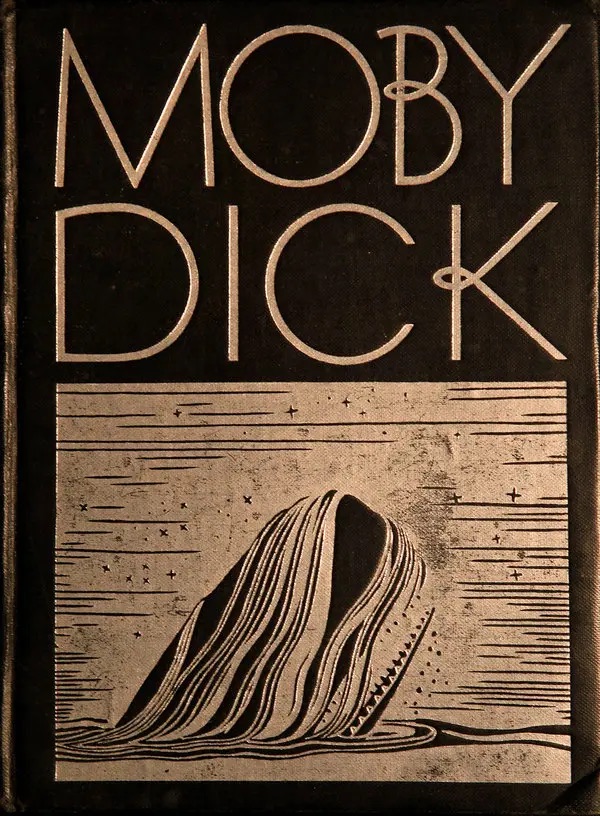
Book Review: Moby-Dick by Herman Melville
Rating: ★★★★★ (5/5)
Herman Melville’s Moby-Dick, first published in 1851, is one of the most complex and enduring novels in American literature. What initially appears to be a straightforward whaling adventure soon transforms into a deeply philosophical and symbolic meditation on obsession, fate, revenge, and the limits of human knowledge. While Moby-Dick was not widely appreciated during Melville’s lifetime, it has since been recognized as one of the greatest novels ever written.
At over 600 pages, Moby-Dick is a dense and often challenging read, filled with rich symbolism, encyclopedic knowledge of whales and whaling, and an unforgettable cast of characters. Its narrative style shifts between thrilling adventure and intricate philosophical musings, making it a book that rewards patience and close reading.
Plot Summary: The Hunt for the White Whale
The novel is narrated by Ishmael, a young sailor who embarks on a whaling voyage aboard the Pequod, a ship captained by the enigmatic and obsessed Ahab. From the moment Ishmael sets foot in New Bedford, where he meets his companion, the harpooner Queequeg, the novel establishes itself as both an epic adventure and a deeply symbolic tale of human struggle.
As the Pequod sets sail, it becomes clear that the voyage is not just about hunting whales for oil. Captain Ahab has a singular, almost supernatural focus: hunting down Moby Dick, the massive white whale that maimed him by biting off his leg on a previous expedition. Ahab’s pursuit of the whale is relentless, bordering on madness, and his obsession begins to consume not just him but the entire crew of the Pequod.
Throughout the novel, Melville intersperses thrilling encounters with whales with digressions into philosophy, history, and natural science. The book reaches its dramatic climax when Ahab finally confronts Moby Dick, leading to an unforgettable and catastrophic showdown.
Characters: The Souls Aboard the Pequod
Melville’s characters are among the most memorable in literature, each representing different aspects of human nature and philosophy.
Ishmael
As the novel’s narrator, Ishmael serves as the reader’s guide through the whaling world. He is thoughtful, observant, and prone to philosophical reflection. His famous opening line, “Call me Ishmael,” immediately establishes the novel’s deeply personal and introspective tone.
Captain Ahab
Ahab is the heart of Moby-Dick and one of literature’s most fascinating and tragic figures. His obsession with revenge against Moby Dick is all-consuming, driving him to defy nature, the gods, and even his own crew. He is a complex character—both heroic in his determination and monstrous in his disregard for the lives around him. Ahab’s character raises deep existential questions: Is he a man of destiny or self-destruction? Is he a tragic hero or a villain?
Queequeg
Queequeg, the tattooed Polynesian harpooner, is one of the novel’s most endearing characters. Despite coming from a vastly different culture than Ishmael, he forms a deep bond with him, symbolizing the novel’s themes of brotherhood and the universality of human experience. Queequeg is strong, noble, and wise in ways that contrast with the more cerebral Ishmael.
Starbuck
Starbuck, the first mate of the Pequod, serves as Ahab’s moral counterpoint. He is a rational and religious man who recognizes the madness of Ahab’s quest yet is powerless to stop it. Starbuck represents duty, caution, and the struggle between faith and reason.
Moby Dick (The White Whale)
Though an animal, Moby Dick is far more than just a whale—he is a symbol of nature’s power, the unknown, and the limits of human control. He represents different things to different characters: to Ahab, he is the embodiment of evil and fate; to others, he is merely a whale, indifferent to human affairs.
Themes: A Profound Exploration of the Human Condition
Moby-Dick is a novel rich with themes, many of which have made it a timeless piece of literature.
Obsession and Revenge
Ahab’s pursuit of Moby Dick is one of the most famous portrayals of obsession in literature. His desire for revenge transcends reason, morality, and even self-preservation. This theme questions the nature of human ambition—when does passion become self-destruction?
Fate vs. Free Will
The novel frequently grapples with the idea of fate. Is Ahab destined to chase Moby Dick, or does he choose this path? Melville plays with the idea that some forces—whether divine, natural, or psychological—are beyond human control.
The Power of Nature
The vastness of the ocean and the might of the whale serve as a reminder of humanity’s insignificance in the grand scheme of the universe. Nature is depicted as both beautiful and terrifying, a force that can neither be tamed nor fully understood.
Brotherhood and Diversity
The Pequod’s crew is made up of men from all over the world, each bringing their own beliefs, traditions, and perspectives. This diversity highlights themes of unity and human connection, even in the face of a shared, doomed mission.
Melville’s Writing Style: A Unique Narrative Approach
One of the reasons Moby-Dick is such a challenging but rewarding read is its distinctive narrative style. Melville blends multiple genres—adventure, philosophy, science, and even Shakespearean drama—into one epic story.
The novel frequently shifts between different modes of storytelling. Some chapters are purely narrative-driven, focusing on the action and interactions between characters. Others are deeply philosophical, exploring topics such as the nature of evil, the limitations of human perception, and the role of destiny. There are also highly technical chapters dedicated to the whaling industry, complete with detailed descriptions of whale anatomy, ship mechanics, and historical accounts of whaling practices.
While some readers find these digressions overwhelming, they add to the novel’s depth, making it not just a story about a man hunting a whale, but a meditation on existence itself.
Why Moby-Dick is a Timeless Classic
Despite being over 170 years old, Moby-Dick remains one of the most analyzed and discussed books in literature. Its themes of obsession, fate, and the struggle between man and nature continue to resonate. Many modern readers see Ahab’s relentless pursuit as a metaphor for contemporary struggles—whether political, environmental, or personal.
The novel’s influence can be seen in countless works of literature, film, and even philosophy. Writers such as William Faulkner, Ernest Hemingway, and Cormac McCarthy have cited Moby-Dick as a major inspiration. Its themes have been adapted into countless other narratives, proving that its core questions about humanity remain relevant.
Who Should Read Moby-Dick?
Moby-Dick is not a light read. Its length, detailed descriptions, and philosophical passages require patience. However, for readers who enjoy deep, thought-provoking literature, it is an immensely rewarding experience.
If you are a fan of classic literature, philosophical novels, or adventure stories with deeper meaning, Moby-Dick is a must-read. Those interested in themes of obsession, fate, and the power of nature will find the novel especially compelling.
Final Thoughts: A Masterpiece of American Literature
Moby-Dick is much more than a novel about a whaling voyage—it is a profound exploration of the human soul. With its unforgettable characters, rich symbolism, and deep philosophical insights, it is a book that continues to captivate and challenge readers.
Though it was largely overlooked in Melville’s lifetime, today it stands as one of the greatest literary achievements in history. Whether you read it for its adventure, its themes, or its poetic language, Moby-Dick is a novel that stays with you long after the final page is turned.
Final Rating: 5/5 – A timeless, thought-provoking masterpiece.



 Book Reviews Online
Leave a comment