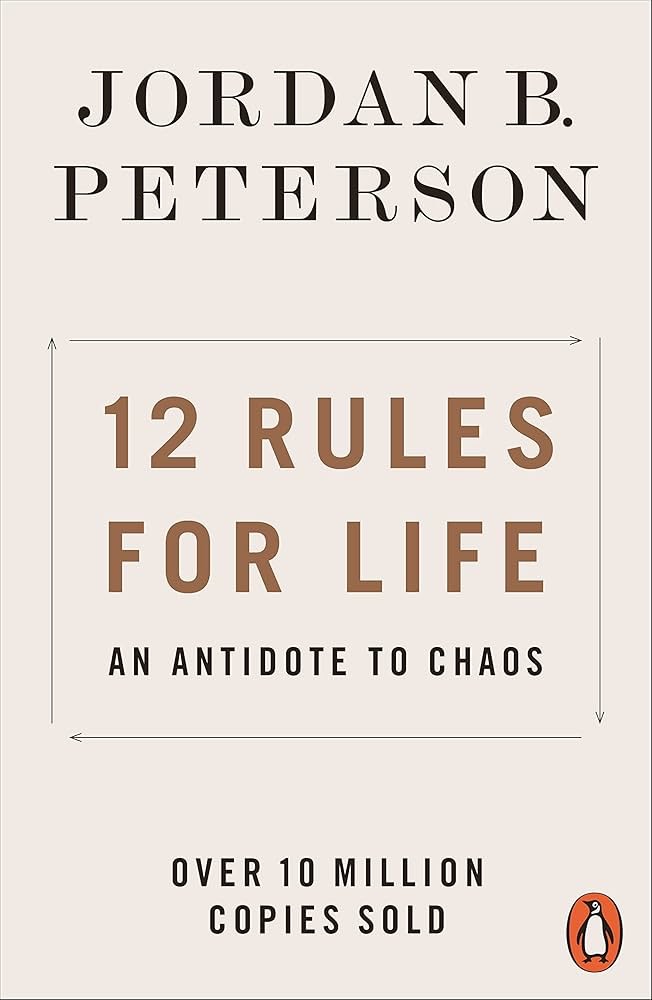
Author: Jordan B. Peterson
Rating: ★★★★☆ (4.5 out of 5 stars)
In a world that often feels overwhelmed by uncertainty, complexity, and moral confusion, 12 Rules for Life: An Antidote to Chaos by Jordan B. Peterson delivers a bold, intellectual, and deeply philosophical response. A clinical psychologist and professor of psychology, Peterson blends ancient wisdom, psychology, religion, and personal anecdotes into 12 transformative principles meant to help readers live a more meaningful and responsible life. In this review, we’ll explore the key themes, practical lessons, and cultural significance of this global bestseller.
Overview of 12 Rules for Life
12 Rules for Life was published in 2018 and quickly became a publishing phenomenon, topping bestseller lists worldwide. The book presents twelve life principles that, according to Peterson, are rooted in timeless truths from mythology, religion, psychology, and evolutionary biology.
These aren’t just self-help tips—they’re philosophical meditations on responsibility, suffering, discipline, and the human condition. Peterson argues that life is hard, suffering is inevitable, and meaning is found through responsibility, order, and the pursuit of truth—not through pleasure or materialism.
Each chapter is built around a “rule,” such as “Stand up straight with your shoulders back” or “Tell the truth—or, at least, don’t lie,” which is then explored through a mix of narrative, science, theology, and personal reflection.
Key Takeaways and Lessons
1. Rule 1: Stand Up Straight With Your Shoulders Back
Posture is more than physical—it reflects and influences your psychological state. Peterson draws from lobsters and dominance hierarchies to show how confident posture can shift how the world perceives you and how you perceive yourself.
2. Rule 2: Treat Yourself Like Someone You Are Responsible for Helping
Most people care for others better than they care for themselves. Peterson urges readers to take their own needs seriously and show self-compassion paired with responsibility.
3. Rule 6: Set Your House in Perfect Order Before You Criticize the World
Before attempting to fix external problems, Peterson stresses the importance of getting your own life in order—however small the steps may be.
4. Rule 8: Tell the Truth—Or, at Least, Don’t Lie
Truth-telling, Peterson believes, is essential to psychological health and moral clarity. Living dishonestly leads to personal chaos and collective dysfunction.
5. Rule 12: Pet a Cat When You Encounter One on the Street
A poetic closing rule that reminds readers to appreciate small moments of beauty and peace, even amidst life’s unavoidable pain and suffering.
Writing Style and Tone
Peterson’s writing is dense, thoughtful, and academic, with philosophical and religious references woven throughout. While not light reading, it is deeply thought-provoking and intellectually stimulating for those willing to engage.
He seamlessly blends storytelling with scientific studies, biblical analysis, and clinical examples. His tone is earnest and sometimes intense, aiming to provoke reflection rather than entertain. Readers who enjoy depth and complexity will find 12 Rules for Life deeply rewarding.
However, the structure can sometimes feel sprawling. Some chapters dive into tangents that require patience and careful reading, but each ultimately returns to its central lesson.
Who Should Read 12 Rules for Life?
This book is ideal for:
Individuals seeking structure and clarity in a chaotic world Young adults and students exploring purpose and direction Readers of philosophy, psychology, and theology Men and women seeking practical life principles grounded in timeless truths Fans of Viktor Frankl’s Man’s Search for Meaning or Stephen Covey’s The 7 Habits of Highly Effective People
If you’re looking for a guide to life that doesn’t coddle you but challenges you to grow through responsibility, 12 Rules for Life is essential reading.
Critiques and Considerations
While 12 Rules for Life is highly praised, it’s also polarizing. Some critics argue that Peterson’s views on gender roles, tradition, and authority can feel rigid or conservative. Others find the writing style too academic or philosophical for mainstream self-help audiences.
Additionally, the book assumes a high level of cultural and psychological literacy, which may make some chapters difficult for casual readers.
However, its overarching message—find meaning through responsibility and tell the truth even when it’s hard—is universally resonant and deeply needed in today’s cultural climate.
Cultural Impact and Influence
Jordan Peterson has become one of the most talked-about public intellectuals of the 21st century, and 12 Rules for Life has played a major role in that. The book has sparked intense debate, inspired millions, and influenced readers from all walks of life to rethink how they approach discipline, morality, and mental health.
Love him or challenge him, Peterson’s influence on modern discussions around responsibility, freedom, and personal growth is undeniable.
Final Thoughts: Is 12 Rules for Life Worth Reading?
Yes—especially if you’re looking for more than surface-level self-help. 12 Rules for Life is a profound, challenging, and life-affirming book that encourages readers to stop blaming the world and start building themselves into something better.
It’s not about comfort. It’s about growth. And for that reason, it stands out as one of the most meaningful reads in the personal development space.
Final Rating: 4.5 out of 5 stars
Philosophical, powerful, and unapologetically honest—12 Rules for Life is a must-read for those who crave order, responsibility, and meaning in a chaotic world.


 Book Reviews Online
Leave a comment