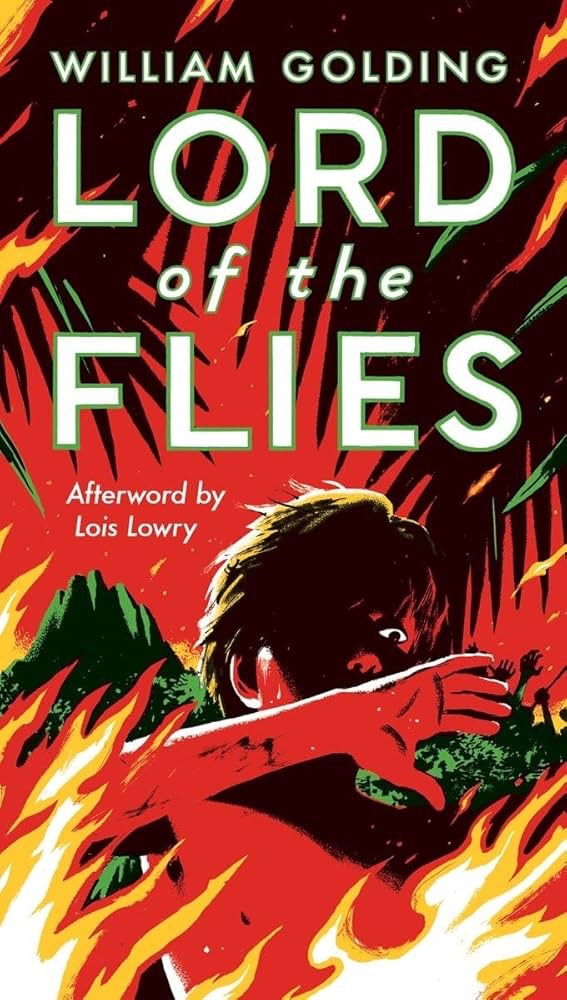
By William Golding
📅 Published: 1954
📚 Genre: Allegorical Novel, Dystopian Fiction
⭐ Rating: ★★★★★ (5/5)
Introduction
William Golding’s Lord of the Flies is a haunting exploration of human nature, civilization, and the thin line between order and chaos. Published in 1954, the novel follows a group of boys stranded on an uninhabited island after a plane crash. What begins as an adventure quickly spirals into a dark and disturbing tale of survival, power struggles, and the innate savagery that lurks beneath the surface of society.
Often studied in schools, Lord of the Flies has remained one of the most influential works in literature, provoking deep discussions about morality, leadership, and the fragility of civilization. Through its gripping narrative and chilling symbolism, Golding crafts a timeless and thought-provoking novel that continues to resonate with readers today.
Plot Summary
The novel begins with a group of British schoolboys stranded on a deserted island after their plane crashes. With no adults to guide them, the boys must fend for themselves, establishing rules and a system of order.
At first, their society seems functional:
- Ralph, a charismatic and fair-minded boy, is elected leader and emphasizes the need for order, shelter, and maintaining a signal fire for rescue.
- Piggy, an intelligent but physically weak boy, becomes Ralph’s advisor, offering logical solutions.
- Jack, the leader of the choir boys, is obsessed with hunting and quickly grows impatient with Ralph’s leadership.
As time passes, the boys’ unity crumbles. Jack forms his own tribe, prioritizing hunting and violence over civilization. He lures others with the promise of freedom, meat, and excitement. His leadership soon descends into brutality, leading to the dehumanization of the group.
The tension between Ralph’s civilization and Jack’s savagery culminates in tragic events, including:
- The accidental killing of Simon, a sensitive boy who realizes the “beast” they fear is actually within themselves.
- The murder of Piggy, symbolizing the complete breakdown of reason and order.
- A savage hunt for Ralph, as Jack’s tribe seeks to eliminate the last remnant of civilization.
Just as Ralph is about to be killed, a naval officer arrives, shocked by the boys’ transformation. The novel ends with Ralph weeping for the loss of innocence and the darkness of human nature.
Themes & Analysis
1. Civilization vs. Savagery
The novel’s core conflict is the struggle between order and chaos. Ralph represents civilization, law, and structure, while Jack embodies primal instincts, aggression, and anarchy.
Golding suggests that without societal constraints, humans naturally descend into violence and savagery. The boys start with rules and democracy, but as fear and power struggles take over, they revert to a more primitive state, driven by the need for dominance and survival.
2. The Loss of Innocence
The boys’ descent into savagery represents the loss of childhood innocence. At the start, they see the island as a playground, but as violence consumes them, they become unrecognizable from the disciplined schoolboys they once were.
Ralph, in particular, undergoes a heartbreaking transformation. By the end of the novel, he realizes that the true “beast” is human nature itself. His tears in the final scene reflect his loss of innocence and the realization that civilization is only a thin veneer over humanity’s darker instincts.
3. The Nature of Evil
Golding suggests that evil is not an external force but an intrinsic part of human nature. This idea is best represented through “The Lord of the Flies,” a pig’s head on a stick that Simon hallucinates speaking to him. The head tells Simon that the beast isn’t something that can be hunted or killed—it exists within each of them.
This revelation aligns with Golding’s belief that humans are inherently capable of evil when societal constraints disappear. The boys don’t become savages because of external circumstances; they reveal what was always inside them.
4. Leadership and Power
The novel examines different leadership styles:
- Ralph’s leadership is based on democracy, order, and long-term survival. He tries to create a structured society where everyone contributes.
- Jack’s leadership is based on fear, violence, and immediate gratification. He manipulates the boys by appealing to their primal instincts.
Golding explores how easily people can be swayed by charismatic but ruthless leaders, especially when fear and desperation take hold. Jack’s rise to power mirrors historical examples of dictatorships, showing how quickly civilization can crumble under the wrong leadership.
Symbolism
Golding masterfully weaves symbolism throughout the novel, deepening its themes:
- The Conch Shell – Represents law, order, and civilization. When it is destroyed, it signifies the complete breakdown of society.
- The Lord of the Flies (Pig’s Head) – A symbol of human evil and the darkness within. It serves as a reminder that the beast is not external but a part of them.
- Piggy’s Glasses – Represent intelligence and rational thought. As they are damaged, so too is logic and reason.
- The Signal Fire – Symbolizes hope and the desire to return to civilization. When neglected, it represents the boys’ loss of interest in being rescued.
- The Beast – A manifestation of fear and the unknown. The boys’ belief in an external monster reflects their inability to recognize the true threat—themselves.
Writing Style and Narrative Techniques
Golding’s writing is immersive, using vivid descriptions and psychological depth to create a haunting atmosphere.
- Descriptive Imagery – The island is painted with beautiful yet eerie descriptions, reinforcing the contrast between paradise and the darkness that unfolds.
- Allegorical Depth – Lord of the Flies is not just a survival story; it’s a profound allegory about human nature, making it rich with deeper meaning.
- Psychological Realism – The boys’ descent into savagery is gradual and believable, making their transformation all the more disturbing.
Impact and Legacy
Since its publication, Lord of the Flies has remained one of the most widely studied and debated novels. Its themes of power, morality, and human nature have made it a staple in literature classes and an essential read for those interested in psychological and philosophical questions.
However, the novel has also faced controversy for its violent content and pessimistic view of humanity. Some critics argue that Golding’s portrayal of innate human evil is overly cynical, while others see it as a necessary warning about the dangers of unchecked power and savagery.
Despite debates, Lord of the Flies remains a thought-provoking classic that forces readers to question the stability of civilization and the darkness within us all.
Final Thoughts
Lord of the Flies is a gripping and unsettling novel that explores the fragile nature of society, the lure of power, and the depths of human savagery. Golding’s masterful storytelling and symbolic depth make it a must-read for those interested in psychology, philosophy, and human behavior.
📢 Who Should Read It?
✅ Fans of thought-provoking literature
✅ Readers who enjoy allegorical and dystopian fiction
✅ Anyone interested in the psychological aspects of human nature
💬 What are your thoughts on the novel’s themes and symbolism? Let’s discuss! ⬇️