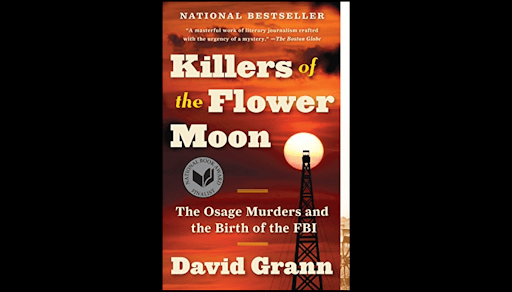
Author: David Grann
Genre: Narrative nonfiction, true crime, American history
Rating: 4.5 out of 5
The most unsettling thing about Killers of the Flower Moon is how ordinary some of its villains initially seem. They’re neighbors, businessmen, and relatives. They show up at funerals. They offer help to grieving families. And in David Grann’s account of the Osage murders, proximity to the victims is often exactly what gives the perpetrators their power.
Grann’s bestselling book begins with the killings of members of the Osage Nation in 1920s Oklahoma. It reads like a murder mystery at first, with disappearing witnesses, suspicious deaths, and an investigation that keeps stalling. By the end, the question that stays with you is how many deaths never made it into the official story.
What Is Killers of the Flower Moon About?
Oil discoveries beneath Osage land brought substantial wealth to members of the Osage Nation. The rights to a share of the mineral income, known as headrights, could pass through inheritance. Grann shows how people close to Osage families saw an opportunity in that arrangement and how a system of court-appointed guardians gave white men control over the finances of many Osage adults.
At the center of the book is Mollie Burkhart, an Osage woman whose family suffers a series of suspicious deaths. Following Mollie gives the first part of the book its emotional weight. Each death takes someone she loves and leaves her with fewer people she can trust. By the time federal investigator Tom White enters the story, the reader understands why solving the case will require more than finding a witness willing to talk.
Why David Grann’s Approach Works
Grann is particularly good at making financial and legal details matter to the story. A headright could sound like a technicality. Once you follow who stands to inherit it, a marriage or a death in the family takes on a frightening new significance. The explanation is clear enough that you can follow the money without losing sight of the people whose lives it shaped.
The book’s structure does even more work. The opening follows Mollie and her family. The middle follows White as he tries to build a case. The final section follows Grann’s own reporting, reopening questions that the investigation seemed to settle. That last shift is the book’s best decision. By then, you’ve spent enough time inside a conventional detective story to feel the pull of a verdict. What Grann finds in the records and hears from descendants makes that sense of closure hard to justify.
There’s also real restraint in how Grann handles the violence. The details are disturbing, but the book rarely dwells on them for effect. A funeral, a conversation, or a gap in the historical record can tell you as much about the atmosphere of fear as the description of a killing.
Where the Book Falls Short
The middle is gripping, but the switch to Tom White comes at a cost. After spending the opening chapters with Mollie, I wanted more of her perspective as the investigation closed in on people she knew. The records give Grann more material about the investigators than about much of Mollie’s private life. You can feel that imbalance in the finished book, especially when the detectives get to explain their reasoning in more detail than the people who had to live with the consequences.
The subtitle, The Osage Murders and the Birth of the FBI, also gives the federal investigation more billing than I think it deserves. White is an engaging figure, and the investigative work makes for some of the book’s fastest reading. I found the final section more memorable because it asks readers to consider how much of the broader violence an official investigation could leave unresolved.
Is Killers of the Flower Moon Worth Reading?
Yes. It’s an easy recommendation if you like true crime that leaves you with something to think about after you know who did it. Grann is as interested in why the crimes could continue as he is in who committed them. That gives the book a wider scope than its central case initially suggests.
The part I kept thinking about was the distance between what could be proven in court and what Osage families had reason to believe about their own losses. Grann leaves room for that uncertainty. It gives the ending a sense of unfinished business that a cleaner detective story would have missed.


Leave a Reply